Your advert gets clicks. Your reports show activity. Your booking calendar stays empty. Before you replace the video or rewrite the landing page, check what those numbers describe.
We had to do that with a Geofilms campaign. A Meta advert sent visitors to our Content Growth page, with a link to book through Cal.com. The reports suggested traffic. The diary told a different story.
We needed to separate a measurement problem from a marketing problem. Both needed examining.
A click is one step in the journey.
An advert click, a landing-page view, a GA4 session and a completed booking describe different events. Treating them as interchangeable hides where the journey stops.
Someone can click twice, leave before the page loads or decline tracking. Platforms also use different attribution rules, reporting windows and filters.
Align the dates, time zones and page URLs before comparing reports. Then check the outcome independently: does the enquiry or appointment exist?
Check what the tracking is actually recording.
WordPress sites often accumulate several integrations. Site Kit, Tag Manager, a directly installed tag and a consent plugin can each affect what happens when a visitor arrives.
The number of tools alone doesn’t establish a fault. Look for the same event being sent twice, an event failing to arrive or a button click labelled as a lead when it only opens a calendar.
Google’s guidance recommends reviewing existing tag installations. Tag Assistant, Tag Manager Preview and GA4’s DebugView help you check what fires and what reaches the property.
Video views need a definition too.
A platform view shows attention according to that platform’s rules. It doesn’t establish that the right buyer understood your offer or intended to enquire.
There is a technical detail to check: GA4’s automatic video measurement supports embedded YouTube videos with the JavaScript API enabled. Vimeo, self-hosted and custom players need their own tracking assessment.
Check whether video_start, video_progress and video_complete arrive before relying on a video report. An empty report is a reason to investigate.
Our campaign showed why the checks matter.
This case study records the investigation on 12 October 2026. It describes what we observed then, rather than a claim about the site’s current configuration.
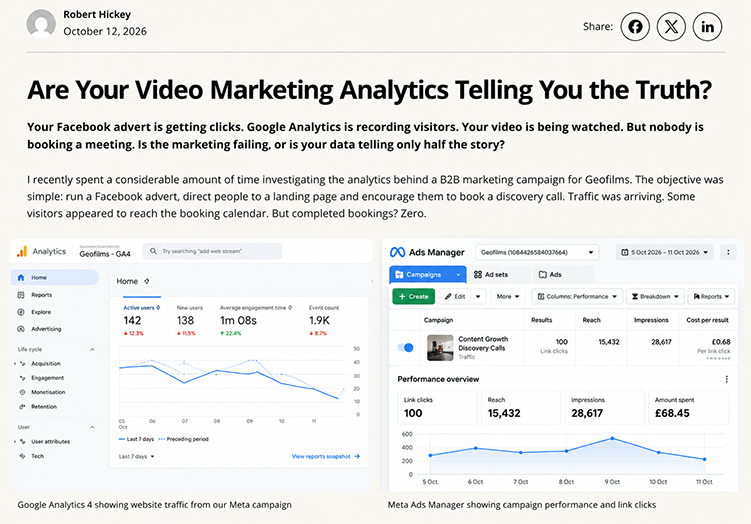
The Meta advert launched on 9 October. By 12 October, its dashboard showed 287 landing-page views and £32.05 spend. GA4 reported six sessions starting on the Content Growth page and nine page views for 9–12 October. Some sessions came from our own Tag Assistant tests.
Those figures were a warning sign. The metrics were different, and the extracts were not independently reconciled to identical cut-off times. They did not prove that exactly 281 visitors had gone unrecorded.
Two consent systems needed attention.
CookieYes and WPConsent had both been active during the earlier troubleshooting. We disabled WPConsent at that time, retained CookieYes as the consent interface and used the WP Consent API with Site Kit.
Our check showed analytics consent denied by default until the visitor granted it. Having competing consent systems was a configuration concern; we did not establish that it explained the entire reporting gap.
The cache changed the visitor experience.
LiteSpeed Cache was deferring Google tracking and consent-related scripts. We added targeted exclusions for the relevant loading sequence.
The first change was insufficient. Guest Mode still deferred scripts for visitors who were not logged in. After adding Guest Mode exclusions and clearing the cache, we verified that the relevant scripts were served without that deferral.
Your WordPress administrator view is not a reliable substitute for a new visitor’s experience. LiteSpeed documents the exclusion settings; each site needs its own test.
The reporting connector had a separate gap.
A third-party connector retrieved older campaign data but did not show the new October advert, which was visible in Meta’s dashboard. A forced refresh was unavailable on its trial plan.
Check the original platform before treating a combined dashboard as the complete record.
A controlled test gave us a useful result.
We opened the Content Growth page in a fresh private window, accepted cookies, waited and refreshed. GA4’s Realtime pages report showed one page view, then two after another refresh.
That demonstrated that the consented page load could produce a recorded view after the changes. It did not prove that every advert visitor was counted correctly.
One snapshot showed four active users and one page view. Those are different metrics. Earlier snapshots also showed engagement and scroll events without a visible page view, which made checking the specific report and event sequence more useful than guessing.
We corrected configuration risks and demonstrated a working test. We did not establish one cause for the whole discrepancy or a verified number of leads attributable to the advert.
Respect consent when fixing measurement.
Low numbers are not a reason to switch consent to granted without the visitor’s choice.
The ICO describes a limited statistical-purposes exception for qualifying measurement used to improve a service. Its conditions include clear information and a simple, free way to object. It is not a blanket exemption for GA4 or other analytics tools.
Storage and access technologies used for online advertising and associated measurement require consent. Separate data-protection obligations can also apply. Assess the purpose and configuration rather than assuming a tool qualifies.
Google Consent Mode adjusts tag behaviour to consent choices. Basic and advanced implementations handle pre-consent signals differently; neither replaces a correctly assessed consent setup.
Follow the journey through to the booking.
Define each stage before building the report:
- Advert click: an interaction with the advert.
- Landing-page visit: arrival at the relevant page, subject to what can be measured.
- Content interaction: a supported video event or another useful page interaction.
- Calendar open: interest in booking, with the appointment still incomplete.
- Confirmed appointment: a booking you can verify in Cal.com.
Record a confirmed outcome as a GA4 key event only when the implementation records that outcome accurately. Any advertising use needs the appropriate technical and consent setup.
Cal.com captures standard UTM parameters when they reach its booking link. These campaign labels help identify the traffic source. Check that they are carried from your site to the calendar; don’t assume they follow automatically.
Test before spending more.
- Choose the outcome. A relevant enquiry or confirmed call gives the campaign a clear purpose.
- Check the tags. Confirm what sends each event and whether it arrives once.
- Test as a new visitor. Follow the route to a controlled booking and check the recorded outcome.
- Test consent choices. Confirm that the setup respects them. Google’s consent implementation guidance explains the sequence.
- Review the offer. If the journey works but enquiries remain low, examine the audience, proposition, evidence and booking process.
Keep traffic before a repair separate from traffic afterwards. A corrected setting does not recreate missing historical events.
The absence of bookings is still a commercial result. Better measurement helps decide what to test next; it doesn’t create demand.
Put measurement in the content brief.
Geofilms plans video, photography and content around the questions people need answered before they enquire. Agree how you will assess the work at the start, with specialist technical support where needed.
Bring the campaign and the question your reports aren’t answering. We’ll help establish what the content needs to do.
Book a free Content Strategy Session. No pressure, no jargon.
Robert Hickey
Founder and Director, Geofilms
Sources and further reading
- ICO: Exceptions for statistics, consent and advertising tracking
- Google: How Consent Mode works
- Google Analytics: Enhanced-measurement video events
- Google: Audit existing tag configurations
- LiteSpeed: JavaScript deferral and Guest Mode exclusions
- Google Analytics: What Realtime pages counts
- Google: Implementing consent updates on websites
- Cal.com: UTM parameters on booking pages